You are driving your truck down the highway, enjoying the open road, when suddenly the smooth ride turns choppy. Your truck shakes, the engine hesitates, and that dreaded little orange icon on your dashboard starts flashing. You pull over, plug in your handy code scanner, and see a single code staring back at you: P0300.
This specific code stands for a random or multiple cylinder misfire. Unlike a code that points directly to a single broken part, P0300 is a bit of a mystery. It tells you that your engine is missing its beat, but it does not tell you exactly why. It is like your truck is coughing, and you have to play detective to find the cure.
Diagnosing this issue might seem scary at first, but you can absolutely figure it out. By breaking the engine down into its core needs, you can track down the culprit and get your truck running perfectly again.
What Exactly is a Misfire?
To fix a misfire, you first need to understand what happens inside your truck’s engine. Your truck relies on an internal combustion engine. This means power is made by burning a mixture of fuel and air inside small chambers called cylinders. Modern trucks usually have six or eight cylinders working together in perfect harmony.
For a cylinder to create power successfully, three main ingredients must come together at the exact same millisecond:
- Air: The engine breathes in oxygen from the outside world through the air filter.
- Fuel: The fuel pump and fuel injectors deliver precise mistings of gasoline or diesel.
- Spark: The spark plug creates a tiny lightning bolt to ignite the air and fuel mixture.
When all three ingredients arrive on time and in the right amounts, a controlled explosion happens. This explosion pushes a piston down, which turns the crankshaft, which eventually turns your wheels.
A misfire occurs when one or more of these ingredients fails to show up, or when the explosion happens at the wrong time. When a cylinder misfires, it stops contributing to the engine’s power. Instead of a smooth rhythm, your engine stumbles because it is missing a beat.
The Difference Between P0300 and Specific Misfire Codes
When you use an automotive scanner, you might see various codes related to misfires. Understanding the difference between these codes will save you a lot of time under the hood.
If your scanner reads P0301, P0302, P0303, or P0304, the computer is telling you exactly which cylinder is failing. The final digit matches the cylinder number. For example, a P0304 code means cylinder number four is the one causing the trouble. This narrows down your search immensely because you can focus all your energy on that single cylinder.
A P0300 code is different. It means the computer detects misfires happening across multiple cylinders randomly, or the misfire is jumping around so fast that the computer cannot pinpoint just one spot. This usually indicates a system-wide issue rather than a single broken spark plug or a single failed ignition coil. It means whatever is causing the problem is affecting the entire engine.
Gather Your Diagnostic Toolkit
Before you dive under the hood of your truck, you need to collect the proper tools. Having the right gear nearby makes the job much more manageable and helps you test parts accurately without guessing.
The Essential Tools
- OBD-Two Scanner: A basic code reader can tell you the code, but a more advanced scanner that shows live data is even better. Live data allows you to watch the misfire counters in real time while the engine runs.
- Spark Plug Socket and Ratchet: You will need a special socket with a rubber insert inside to pull out the spark plugs safely without cracking the delicate porcelain insulation.
- Gap Gauge or Feeler Gauge: This tool measures the tiny distance between the tips of your spark plugs to ensure they can create a strong spark.
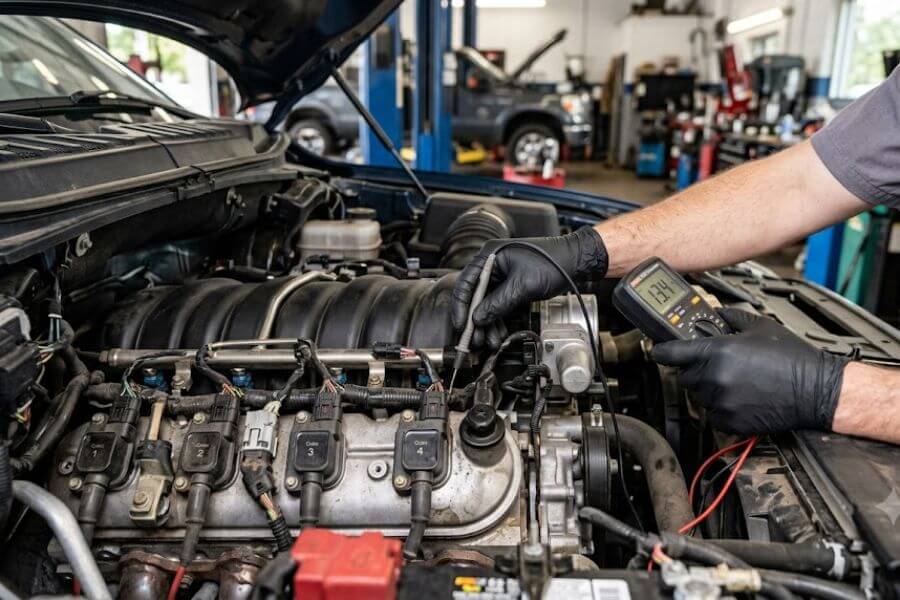
- Digital Multimeter: This handy device measures electrical voltage, resistance, and current. It is vital for testing wires, sensors, and ignition coils.
- Fuel Pressure Gauge: This tool connects to the fuel rail on your engine to measure how hard the fuel pump is pushing fuel forward.
- Vacuum Pressure Gauge: A simple gauge that connects to a vacuum line on the engine to check for hidden air leaks or internal mechanical blockages.
Safety Equipment
- Safety Glasses: Engines can spray fuel, drop dirt, or throw sparks. Protect your eyes at all times.
- Mechanic Gloves: Gloves protect your hands from painful scrapes, hot metal parts, and harsh chemicals.
- Flashlight or Work Light: Modern truck engine bays are crowded and dark. A bright light helps you see deep into the engine compartments.
Step One: Look and Listen for Clues
The very first phase of diagnosing a P0300 code does not require any heavy tools at all. It just requires your senses. Many engine problems leave visible or audible clues that can point you in the right direction immediately.
Open the hood of your truck while the engine is turned off. Start by checking the overall condition of the engine bay. Look for any loose black rubber hoses. These are vacuum lines, and if they are split, cracked, or disconnected, they will let unmetered air into the engine, causing a misfire.
Next, inspect the electrical wiring harnesses. Modern trucks use complex wiring systems to control everything. Look for wires that look melted from touching hot exhaust parts, or wires that have been chewed on by mice or squirrels.
Now, start the truck and let it idle while you safely stand to the side. Listen closely. Do you hear a loud hissing sound? A hissing noise almost always means air is leaking into the engine where it should not be. Do you smell raw gasoline? A strong fuel smell could mean a leaking fuel line or an injector that is stuck wide open, flooding the cylinder with too much fuel.
Step Two: Investigate the Ignition System
The ignition system is responsible for creating the spark that lights the fire inside your cylinders. It is one of the most common areas where a misfire begins. In modern trucks, the ignition system usually consists of individual ignition coils sitting directly on top of each spark plug. This design is called a coil-on-plug system.
Inspecting the Spark Plugs
Remove the ignition coil from one of the cylinders and use your spark plug socket to carefully unscrew the spark plug. Take a close look at the tip of the plug. The condition of the spark plug tip tells a detailed story about what is happening inside the dark cylinder.
- Normal Plug: The tip should look clean with a light tan or greyish color.
- Worn Plug: If the metal electrodes at the tip look rounded, thin, and heavily worn down, the spark plug is too old. The gap between the electrodes becomes too wide for the electricity to jump across, causing a misfire.
- Fouled Plug: If the tip is covered in black oily sludge or wet black soot, it is fouled. This means either too much fuel or oil is entering the cylinder, shorting out the spark before it can light the fuel.
- Blistered Plug: If the tip looks melted or stark white, the cylinder is running dangerously hot, which can destroy engine parts quickly.
Testing the Ignition Coils
If the spark plugs look decent, the problem might lie within the ignition coils themselves. An ignition coil takes low voltage from the truck’s battery and multiplies it into thousands of volts of electricity to create a strong spark.
To test your ignition coils using live data on your scanner, note which cylinders are registering the highest number of misfires. Turn off the engine and swap the ignition coil from a misfiring cylinder with a coil from a perfectly healthy cylinder. Clear the codes and restart the truck. If the misfire moves to the new cylinder, you know with absolute certainty that the ignition coil you moved is broken and needs to be replaced.
Step Three: Inspect the Fuel Delivery System
An engine needs a constant, steady supply of fuel to run smoothly. If the fuel pressure drops or if the fuel cannot get into the cylinders properly, the engine will lean out, meaning there is too much air and not enough fuel. This imbalance leads directly to a P0300 code.
Checking Fuel Pressure
Locate the test port on your truck’s fuel rail, which looks like a small bicycle tire valve. Connect your fuel pressure gauge to this port securely. Turn the truck’s key to the on position without cranking the engine. You should hear the fuel pump buzz for a few seconds as it builds pressure.
Look at the gauge needle. Compare the reading to the factory specification found in your truck’s repair manual. If the pressure is significantly lower than specified, your engine is starving for gas. This low pressure could be caused by a clogged fuel filter, a dying fuel pump, or a faulty fuel pressure regulator.
Evaluating the Fuel Injectors
Fuel injectors are tiny, electronically controlled valves that spray a super-fine mist of fuel into each cylinder. Over time, these injectors can become clogged with carbon deposits or dirt from poor-quality fuel.
You can use your digital multimeter to test the electrical health of the injectors. Set the meter to measure resistance in ohms. Unplug the electrical connector from an injector and touch the meter probes to the two metal pins inside the injector socket. Every injector on your engine should show nearly identical resistance numbers. If one injector shows an open circuit or vastly different resistance, its internal electromagnetic coil is broken.
Another old school trick is to place a long screwdriver against the body of a running fuel injector and press your ear to the handle. You should hear a clear, rhythmic clicking sound. That clicking sound means the injector valve is opening and closing rapidly. If an injector is silent, it is not getting power, or it is completely stuck.
Step Four: Search for Air and Vacuum Leaks
Modern trucks use sensors to measure every single cubic inch of air that enters the engine. The computer then calculates exactly how much fuel to add based on that air measurement. If unmetered air sneaks into the engine through a leak, the computer’s calculations will be completely wrong, causing a lean misfire across multiple cylinders.
The Mass Air Flow Sensor
The Mass Air Flow sensor, or MAF sensor, sits inside the plastic intake tube right after your air filter box. It uses a tiny heated wire to measure the volume and temperature of incoming air. If this wire gets coated in dust, dirt, or oil from an over-lubricated aftermarket air filter, it will miscalculate the air volume.
A dirty MAF sensor often causes a random P0300 misfire because it affects the fuel calculation for the entire engine simultaneously. You can fix this by removing the sensor and spraying it carefully with a dedicated chemical called MAF sensor cleaner. Never touch the delicate wires inside with your fingers or a brush, as they break incredibly easily.
Hunting for Vacuum Leaks
Vacuum leaks allow outside air to enter the engine behind the MAF sensor, bypassing the computer’s radar entirely. These leaks are usually worst when the engine is idling because that is when engine vacuum pressure is at its highest point.
To find a hidden vacuum leak, you can use a few different methods:
| Method | How It Works | What To Look For |
| Visual Inspection | Inspect every single inch of vacuum line with a bright flashlight. | Look for splits at connection points, dry rot cracks, or burns. |
| The Water Spray Trick | Spray a gentle mist of clean water around the intake manifold gaskets while the engine idles. | If the engine idle suddenly changes or smooths out, the water has temporarily blocked an open air leak. |
| The Smoke Test | Pump thick cosmetic smoke into the main engine intake tube using a specialized smoke machine. | Watch closely to see where smoke begins billowing out of hidden cracks or gaskets. |
Common places for major vacuum leaks include the rubber intake boot between the air box and throttle body, the intake manifold gaskets where the plastic manifold meets the metal engine block, and the brake booster vacuum hose.
Step Five: Check for Mechanical and Compression Issues
If you have verified that your ignition system creates beautiful sparks and your fuel system delivers plenty of clean fuel, the problem might be mechanical. For an engine to run, the cylinders must be airtight so they can trap and compress the air and fuel mixture tightly before igniting it.
If a cylinder cannot hold pressure, the explosion will be weak or non-existent, causing a misfire. Mechanical issues often show up as a consistent misfire that does not go away when the engine warms up or speeds up.
Performing a Compression Test
A compression test measures how much pressure your engine’s pistons can create inside the cylinders. To perform this test, you must disable the fuel pump and ignition system so the truck cannot actually start up. Remove all the spark plugs from the engine.
Thread your compression gauge into the first spark plug hole until it is snug. Have a helper press the gas pedal all the way to the floor to open the throttle valve fully, then crank the engine over for about five seconds. Watch the gauge needle rise and note the highest number it reaches. Repeat this exact process for every single cylinder on your truck.
A healthy modern truck engine should generally show compression numbers between 120 and 180 pounds per square inch, or PSI. What matters most is consistency. Every single cylinder should be within ten percent of each other. If one or two cylinders show very low compression compared to the rest, those cylinders have internal mechanical damage.
Common Mechanical Causes of Low Compression
- Leaking Valves: The intake and exhaust valves at the top of the cylinder must seal perfectly. If they get coated in heavy carbon deposits or warp from overheating, they let pressure escape into the intake or exhaust tracts.
- Worn Piston Rings: Piston rings wrap around the sides of the piston to seal the gap between the piston and the cylinder wall. If they wear out or get stuck, pressure blows past them down into the engine’s oil pan.
- Blown Head Gasket: The head gasket is a heavy duty seal sandwiched between the engine block and the cylinder head. If this gasket burns through or cracks between two adjacent cylinders, pressure will bleed back and forth between them, causing a random P0300 code across both cylinders.
Step Six: Test Critical Engine Sensors
Modern truck engines are entirely managed by electronic control units that act as the brain of the vehicle. This brain relies heavily on a team of sensors to know exactly where the pistons are and how much oxygen is left in the exhaust gases. If one of these vital sensors begins sending warped or delayed data, the computer will mistime the fuel and spark events, triggering a P0300 code.
The Crankshaft Position Sensor
The Crankshaft Position Sensor, or CKP, is the most important sensor when it comes to misfires. It monitors the exact rotational speed of the engine’s crankshaft. Every time a cylinder fires successfully, the crankshaft gets a tiny boost in speed.
If a cylinder misfires, the crankshaft slows down for a tiny fraction of a second. The computer detects this tiny slowdown and flags it as a misfire. If the crankshaft sensor itself gets coated in metallic debris or begins failing internally due to engine heat, it might start reporting incorrect speed data, causing the computer to falsely trigger a P0300 code even if the engine is running mechanically fine.
Oxygen Sensors and Fuel Trims
Oxygen sensors sit inside your truck’s exhaust pipes to measure how much unburned oxygen is leaving the engine. The computer looks at this data constantly to adjust its fuel delivery. This adjustment process is known as fuel trim.
You can look at fuel trims using your OBD-Two scanner’s live data screen. Fuel trims are shown as percentages:
- Positive Fuel Trims (+10% or higher): This means the computer detects too much oxygen in the exhaust, so it is actively adding extra fuel to compensate for a lean condition. This points toward vacuum leaks or low fuel pressure.
- Negative Fuel Trims (-10% or lower): This means the computer detects too little oxygen, so it is cutting back on fuel because the engine is running too rich. This points toward leaking injectors, a blocked air filter, or an exhaust restriction.
If your fuel trims are extremely high or low across both sides of a V6 or V8 engine, you are dealing with a widespread issue that is triggering your random P0300 code.
Step Seven: Check for Exhaust Restrictions
An engine is essentially a giant air pump. It breathes air in through the front, compresses it, burns it, and pushes it out through the back. If the air cannot escape through the exhaust system freely, the engine will choke on its own waste gases. This backpressure prevents fresh air from entering the cylinders on the next cycle, causing widespread random misfires.
The most common cause of an exhaust restriction is a failed catalytic converter. The inside of a catalytic converter contains a delicate ceramic honeycomb structure coated in precious metals designed to clean up exhaust emissions.
If your engine has been running rich or burning oil for a long time, that raw fuel or oil can travel down into the hot catalytic converter and melt the ceramic honeycomb structure completely closed. This creates massive backpressure.
You can test for an exhaust restriction easily using a vacuum gauge connected to the engine intake manifold. Start the truck and hold the engine speed at around 2500 RPM steady. If the vacuum needle starts out high but slowly drops lower and lower towards zero while you hold the RPM steady, your exhaust system is blocked, and the engine is suffocating.
Real World Diagnostic Strategy
When you are facing a confusing P0300 code, you do not want to just start throwing random expensive parts at your truck hoping something fixes it. That approach wastes your hard earned money and causes massive frustration. Instead, you should approach the problem step by step using a logical strategy.
[Start Check] ---> [Scan Live Data & Misfire Counters]
                          |
                          v
               [Inspect Engine Bay for Vacuum Leaks]
                          |
                          v
               [Test Fuel Pressure and Check Fuel Quality]
                          |
                          v
               [Inspect Spark Plugs and Move Ignition Coils]
                          |
                          v
               [Perform Engine Compression Testing]
                          |
                          v
[Problem Solved] <--- [Repair Identified Faulty Component]
By following this exact path, you eliminate variables one by one. You will find the root cause of the P0300 code without wasting time or buying parts you do not actually need.
Frequently Asked Questions
Can I drive my truck with a P0300 code?
You should not drive your truck for long distances with an active P0300 code, and you should absolutely never drive it if the check engine light is actively flashing. A solid check engine light means a fault is present, but the truck can still be driven carefully to a safe repair spot. A flashing check engine light means a severe misfire is actively occurring right that second.
When an engine misfires severely, raw unburned fuel is pumped straight out of the cylinder and directly into your exhaust system. When this raw fuel hits your super hot catalytic converter, it ignites inside the converter, causing temperatures to skyrocket. This extreme heat can melt your catalytic converter internally within minutes, turning a simple repair into a massive expense. If your check engine light is flashing, pull over safely and turn the truck off immediately.
Will a dirty engine air filter cause a random misfire?
A dirty engine air filter can absolutely contribute to a P0300 code, especially if it is heavily neglected. Your truck’s engine needs to breathe a massive amount of clean air to perform its combustion process correctly. If the air filter is completely clogged with thick dust, leaves, and road grime, it acts like a pillow held over the engine’s mouth.
This severe air restriction throws off the delicate air and fuel balance inside the cylinders, which can lead to random stumbling and misfires across the entire engine block. Checking your air filter is a great routine habit, as it is incredibly fast to inspect and replace if needed.
Why does my truck only misfire when the engine is cold?
If your truck only experiences a random misfire during the first few minutes after a cold morning start and then runs beautifully once the engine warms up, you are likely dealing with leaking intake manifold gaskets or a minor coolant leak.
Many modern trucks utilize plastic intake manifolds with rubber gaskets. When the engine is cold, the metal and plastic parts contract and shrink slightly. This contraction can create a temporary gap around the gaskets, allowing unmetered air to leak in and cause a cold misfire.
As the engine runs, the metal and plastic expand from the engine heat, squeezing the rubber gaskets tight and sealing the leak completely, which makes the misfire vanish. Another possibility is a tiny head gasket leak that allows a drop of engine coolant to seep into a cylinder overnight, wetting the spark plug tip until it burns off after a few seconds of running.
Can bad fuel cause a P0300 trouble code?
Bad or contaminated fuel is one of the most common causes behind a sudden random P0300 code. If you recently visited a gas station and filled up your tank, and your truck started running terribly just a few miles down the road, you likely bought a batch of contaminated fuel.
Gasoline can become contaminated with water if the gas station’s underground storage tanks have hidden leaks, or the fuel could simply be very old and stale. Water is heavier than gasoline, so it settles straight to the bottom of your truck’s fuel tank where the fuel pump sucks it up first.
Since water cannot burn, it disrupts combustion across all your cylinders randomly, triggering a widespread P0300 code. You can fix this issue by draining the bad fuel completely and refilling the tank with clean fuel from a reputable station.
How often should I change my truck’s spark plugs to prevent misfires?
The ideal replacement interval for spark plugs depends heavily on the specific type of metal used on the spark plug tips. Standard copper spark plugs wear down relatively quickly and generally need to be replaced every 30000 to 50000 miles.
Most modern trucks come from the factory equipped with high-quality platinum or iridium spark plugs. These advanced precious metals can withstand extreme heat and electrical erosion for much longer periods, often lasting anywhere from 80000 to 100000 miles before needing replacement.
However, even high-quality plugs can fail early if your engine is burning oil or running excessively rich. Checking your owner’s manual for your truck’s exact recommended service schedule is always your best bet to prevent unexpected misfire codes.