You turn the key. Instead of the familiar purr of your engine, you hear a clicking sound. Or worse, complete silence. Your heart sinks. Your car battery is dead, and you are officially stranded.
It happens to everyone at some point. But in today’s modern vehicles, a dead battery isn’t just an inconvenience; it can be a risk to your wallet. Modern cars are basically rolling computers. They are packed with delicate microchips, navigation screens, and sensitive digital brains. If you jump-start your car the wrong way, a sudden surge of electricity can fry those expensive components.
Do not panic. You can get your car back on the road safely without turning your dashboard into a smoking piece of junk. This guide will walk you through the process, step by step, keeping things clear, simple, and safe.
Understanding the Danger to Your Car’s Digital Brain
Before you grab those heavy cables, it helps to understand what is happening under the hood. Older cars were mostly mechanical machines. If you threw a bunch of electricity at them, they didn’t mind. They just absorbed the power and started up.
Modern cars are completely different animals. They rely on Engine Control Units, or ECUs. These small computers manage everything from how much fuel your engine burns to the temperature of your seat heaters.
What is an Electrical Surge?
When you connect a healthy battery to a dead battery, electricity wants to rush from the full container to the empty one as fast as possible. This sudden rush is called a voltage spike or a power surge. Think of it like a massive wave of water hitting a tiny pipe. If that wave hits your car’s computers without any warning, it can burn out the delicate circuits inside them.
The Cost of a Mistake
Frying an ECU is not like blowing a fuse. Fuses are cheap and simple to replace. A damaged vehicle computer can cost thousands of dollars to fix. It can also cause strange electrical glitches that take mechanics weeks to figure out. That is why following the correct order of steps is the most important part of the entire process.
Why Grounding Matters
You might wonder why you do not just connect positive to positive and negative to negative on both batteries. Connecting the negative cable directly to the dead battery can cause a spark right next to the battery itself. Lead-acid batteries release hydrogen gas when they are working or dying. A single spark can ignite that gas, causing a dangerous explosion. Grounding the cable away from the battery removes that risk entirely.
Gathering Your Tools and Staying Safe
You need the right gear and the right mindset before you touch anything under the hood. Safety is not about being scared; it is about being smart and prepared.
The Essential Gear Checklist
- Jumper Cables: Look for cables that are thick and heavy. Thick cables have lower gauge numbers, like 4-gauge or 2-gauge. They carry electricity better and stay cooler than thin, cheap cables.
- A Booster Vehicle: You need a second car with a working battery that runs at the same voltage as yours. Almost every modern passenger car uses a 12-volt system. Do not try to jump-start a standard car with a heavy-duty semi-truck or a tiny scooter.
- Safety Glasses: These protect your eyes from any unexpected sparks or dirt that might fly up when the engine starts.
- Work Gloves: Mechanics use these to protect their hands from scrapes, battery acid, and heat.
- A Clean Rag: This helps you wipe away dirt or corrosion from the battery terminals so you get a solid connection.
Preparing the Environment
Park both cars so they face each other, but make sure they do not touch. If the metal bodies of the cars touch, it can create a path for electricity to flow where it should not, causing a massive short circuit.
Set the parking brakes on both vehicles. You do not want either car rolling forward or backward while you are working near the engines. Put both transmissions in Park for an automatic or Neutral for a manual shift. Turn off the ignitions in both cars and remove the keys.
Battery Safety Equipment Comparison
| Equipment | Why You Need It | What Happens Without It |
| Heavy-Gauge Cables | Carries massive starting current safely without melting | Thin wires overheat, drop voltage, and fail to start the engine |
| Safety Glasses | Blocks stray sparks and chemical splashes | Risk of permanent eye injury from battery acid or metallic sparks |
| Mechanic Gloves | Insulates hands from heat and shields skin from acid | Painful chemical burns or skin irritation from battery residue |
| Clean Cloth Rag | Cleans off crusty corrosion for a bright, clean contact | Poor connection that resists electrical flow and causes heat |
Getting to Know Your Car Battery
Take a look at your battery before you attach any clamps. Every battery has two metal posts called terminals. You must identify them correctly, or you could cause a massive electrical fire.
Finding the Plus and Minus Signs
The positive terminal is the most important one. It is usually marked with a plus sign (+) and often has a bright red plastic cover protecting it. The negative terminal is marked with a minus sign (-) and usually has a black cover, or no cover at all.
If the battery is old and covered in grime, you might not see the symbols clearly. Use your rag to wipe away the dirt until you see the molded plastic shapes on the battery case. Never guess which post is which. If you connect a positive clamp to a negative post, you will create an instant, violent short circuit that can destroy both cars’ electrical systems in less than a second.
Checking for Damage
Take a close look at the outer shell of the dead battery. Is the plastic case cracked, split, or leaking fluid? Is the battery bulging out at the sides like a balloon? If you see any of these signs, stop immediately. Do not try to jump-start the car. A damaged battery can leak dangerous acid or burst into flames when you apply power to it. Call a tow truck instead.
Cleaning the Terminals
You will often see a white, green, or blue powdery substance crusting around the metal terminals. This is corrosion. It acts like a rubber wall, blocking the flow of electricity. If your terminals are dirty, the jump-start will not work because the power cannot get through the crust.
Put on your gloves and glasses, and use your rag to scrub that powder away. If it is really stubborn, a wire brush or an old toothbrush can scrub it clean. Do not touch this powder with your bare skin, as it contains dried acid that can irritate your skin.
The Step-by-Step Connection Guide
This is the most critical part of the process. You must connect the clamps in a exact, specific order to keep your car electronics safe. Think of it like a countdown before a rocket launch. Every step has its exact place.
Step 1: Connect Red to Dead
Take the red clamp on one end of your jumper cables. Attach it firmly to the positive (+) terminal of the dead battery. Make sure the metal teeth of the clamp bite deep into the metal post so it will not wiggle or slip off later.
Step 2: Connect Red to Donor
Take the red clamp on the other end of the cables. Walk over to the good car and clamp it onto its positive (+) terminal. Again, ensure a tight, rock-solid grip.
Step 3: Connect Black to Donor
Stay at the good car. Take the black clamp from that same end of the cable and attach it to the negative (-) terminal of the good battery.
Step 4: Connect Black to Ground
This is where many people make a big mistake. Do not walk back to the dead car and put the final black clamp on the dead battery’s negative post.
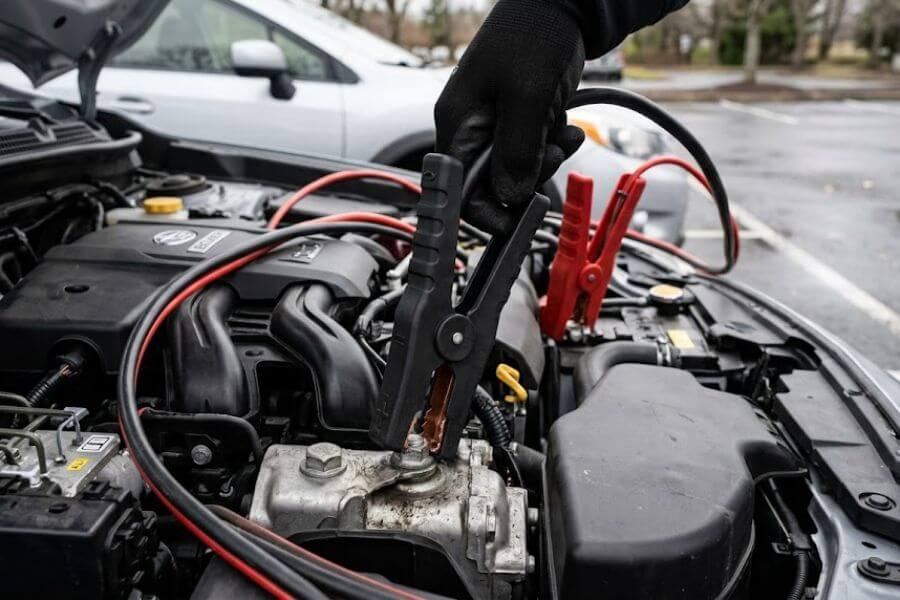
Instead, look for a piece of solid, unpainted metal on the engine block of the dead car. A heavy bolt, a metal bracket, or the clean engine frame works beautifully. Fasten the black clamp to this metal surface. This is your ground connection. By placing this final clamp away from the battery, any spark created by completing the electrical circuit happens far away from any explosive gases.
The Safe Connection Sequence At a Glance
- Red Clamp to the Positive Post of the dead battery.
- Red Clamp to the Positive Post of the good battery.
- Black Clamp to the Negative Post of the good battery.
- Black Clamp to an Unpainted Metal Ground on the dead car.
Starting the Vehicles and Transferring Power
With all four clamps connected securely, you are ready to move the electricity from the good car to the dead one. Do not rush this part. Patience keeps your computers safe.
Starting the Donor Vehicle
Go to the car with the good battery. Insert the key and start the engine. Let it idle normally for a minute or two. Then, gently press the gas pedal to raise the engine speed slightly. You do not need to stomp on it; just a gentle press to keep the engine running a bit faster than normal. This prompts the alternator in the good car to pump out plenty of clean electricity, filling up its own system and getting ready to share.
The Waiting Period
Do not try to start the dead car right away. Let the cars sit connected like this for five to ten minutes. This allows a slow, steady stream of power to enter the dead battery. This slow fill acts like a cushion, warming up the cold, dead battery and reducing the size of any sudden power surge when you finally turn the key.
Cranking the Dead Engine
Walk over to the stranded vehicle. Turn off all accessories inside the car. Make sure the headlights, radio, air conditioning, heater fan, and dome lights are completely off. You want every single drop of available power to go directly to the starter motor, not to your stereo.
Turn the key or press the start button. The engine should crank over and start up. If it cranks slowly but does not catch, give it a few more minutes of charging time and try again. If it starts up, celebrate quietly, but do not touch the cables just yet.
The Safe Disconnection Procedure
Your dead car is now running, but your job is only half done. Disconnecting the cables is just as dangerous for your electronics as connecting them. If you pull the clamps off carelessly and they spark against each other, you can cause the exact electrical surge you worked so hard to avoid.
Leave the Engines Running
Keep both car engines running while you remove the cables. Turning off your newly started car right away might mean it will not have enough power to start back up on its own.
The Exact Reverse Order
You must remove the clamps in the exact opposite order that you put them on. This breaks the electrical circuit safely and prevents accidental short circuits.
Step 1: Remove the Ground
Carefully unclamp the black negative clamp from the unpainted metal surface on the car you just started. Keep this clamp in your hand and make sure it does not touch any other metal parts inside the engine bay.
Step 2: Remove the Donor Negative
Walk over to the good car and remove the black negative clamp from its battery terminal. Hold both black clamps apart so they cannot bump into each other or touch any red parts of the cables.
Step 3: Remove the Donor Positive
Remove the red positive clamp from the good car’s battery. Now you have three clamps free. Keep them separated.
Step 4: Remove the Dead Positive
Finally, remove the red positive clamp from the battery of the car you just resurrected. Coiled up your cables neatly so they are ready for the next time you or a friend needs help.
Disconnection Order Reference
| Action Order | Which Clamp | Location to Remove From |
| First | Black Clamp (Negative) | Unpainted metal ground on the rescued car |
| Second | Black Clamp (Negative) | Negative terminal on the booster car battery |
| Third | Red Clamp (Positive) | Positive terminal on the booster car battery |
| Fourth | Red Clamp (Positive) | Positive terminal on the rescued car battery |
What to Do Immediately After Your Car Starts
Now that your car is running on its own power, you cannot just drive home and park it. Your battery is still very weak, and the car needs time to heal itself.
Keep the Engine Running
Do not turn your car off. Your alternator, which is the onboard generator driven by your engine, needs time to pump electricity back into your battery. If you turn the engine off now, you will be stuck with a dead battery all over again.
Take a Extended Drive
Drive your car for at least thirty to forty five minutes. A quick drive around the block is not enough. You want to drive at highway speeds if possible, because higher engine speeds allow the alternator to charge the battery much more efficiently than sitting at a red light or idling in your driveway.
Limit Electrical Use During the Drive
While you are driving to recharge the battery, give your vehicle a break. Keep the air conditioning on low, leave the heated seats off, and do not plug in three different smartphones to charge. Let all the energy from the engine focus on filling up that empty battery box.
Modern Alternatives: Portable Jump Starter Packs
If the idea of connecting two cars together makes you nervous, or if you are stuck alone in a remote area, there is a fantastic modern tool you should consider buying. It is called a portable jump starter pack.
What is a Jump Starter Pack?
These devices are essentially high-power lithium-ion batteries packed into a small box, much like a giant version of the power bank you use to charge your cell phone. They come with a mini set of jumper cables attached directly to the box.
Why They Are Safer for Electronics
Good quality portable jump packs contain built-in smart chips. These microchips monitor the electrical flow constantly. If you accidentally hook the clamps up backwards, the box will beep loudly and cut off the power, protecting your car’s computers from damage. They also prevent power surges, making them incredibly safe for modern, high-tech vehicles.
How to Use a Portable Pack
Using one is incredibly straightforward. With the pack turned off, connect the red clamp to the positive battery post and the black clamp to the unpainted metal ground. Once everything is secure, turn the power switch on the pack to the on position. Walk into your car, start the engine, and then turn the pack off before removing the clamps in reverse order. It removes the need for a second vehicle entirely.
Signs Your Battery Needs to Be Replaced
A jump-start is a temporary fix. It gets you out of trouble, but it does not fix an old, worn-out battery. You need to know if your battery was just accidentally drained, or if it is dying of old age.
The Age of Your Battery
Most car batteries last between three and five years. If your battery is four years old and dies on a cold morning, it is likely at the end of its natural life. Look for a sticker on the top or side of the battery that lists the date it was made.
Slow Engine Crank
If your car takes a long time to start up on regular days, making a sluggish, heavy sound before it finally catches, your battery is sending you a warning signal. It is losing its ability to hold a strong charge.
Dim Lights and Electrical Quirks
Watch your headlights when you stand still with the engine idling. Do they look dim, but then get much brighter when you press the gas pedal? Do your power windows roll up much slower than they used to? These are classic signs that your electrical system is starved for power.
Testing Your Battery
You do not have to guess. You can drive your car to almost any auto parts store, and they will hook up a digital battery tester for free. In less than two minutes, this tool can tell you exactly how healthy your battery is and whether it is time to buy a new one.
Frequently Asked Questions
Can a hybrid or electric car be used to jump-start a regular gas car?
No, you should never use a hybrid or electric vehicle to jump-start a standard gasoline car. Hybrid and electric cars do have a small 12-volt battery to run their computers, but their main power comes from massive high-voltage battery packs. Their systems are not built to handle the giant, sudden rush of electrical current that a standard gas engine starter motor requires. Trying to do so can instantly damage the incredibly expensive electrical systems inside the hybrid or electric vehicle. However, you can use a regular gas car to jump-start the small 12-volt battery of a hybrid car if that hybrid vehicle fails to turn on.
What should I do if the jumper cables start getting hot to the touch?
If you feel the jumper cables getting warm or hot while trying to start the car, turn off both vehicles immediately and disconnect the cables carefully. Hot cables mean that too much electricity is trying to force its way through the wires, which happens if the cables are too thin or if there is a major problem with the dead car, such as a seized starter motor or a total short circuit. Using hot cables can melt the plastic insulation, cause severe burns, or start an engine fire. Always invest in heavy-duty, thick-gauge cables to prevent this issue.
Is it safe to jump-start a car in the pouring rain or on wet ground?
Yes, it is generally safe to jump-start a car in the rain, provided you follow standard safety precautions. The 12-volt electrical system in a passenger car does not carry enough electrical pressure to shock you through rainwater. However, you must ensure that the internal components of the battery and the cable clamps do not get drenched with water during the process, as water can cause rust and ruin connections. Wipe down the terminals with a dry cloth before connecting the clamps, and ensure your hands are dry enough to handle the tools firmly without slipping.
Why does my car turn off immediately after I disconnect the jumper cables?
If your engine dies the second you remove the jumper cables, your alternator is likely broken. The battery’s job is only to start the engine. Once the engine is running, the alternator takes over and creates all the electricity needed to keep the car running and recharge the battery. If the alternator fails, the car runs entirely off the power left in the battery. Since that battery is dead, the engine stalls as soon as you remove the external power source. You will need to have your alternator tested and replaced by a mechanic.
What is that rotten egg smell coming from my dead battery?
A rotten egg smell means your battery is overheating and releasing sulfur dioxide gas. This happens when a battery is severely overcharged, has internal structural damage, or has suffered a short circuit inside its cells. This gas is highly flammable and dangerous to breathe. If you smell rotten eggs near your car battery, do not attempt to jump-start the car or create any sparks. Step away from the vehicle and call a professional roadside assistance service to handle the situation safely.