Table of Contents
Drag racing is one of the wildest forms of motorsport you will ever see. Two cars line up, launch with unbelievable force, and blast down the track in just a few seconds. The sport looks simple at first, but the numbers behind it are almost hard to believe. Some drag racing records are so extreme that they sound like science fiction instead of real life.
When you look closer, you realize these machines accelerate faster than fighter jets, produce more horsepower than several supercars combined, and cover a quarter mile in less time than it takes you to read this sentence out loud. The drivers also experience brutal physical forces that push the limits of the human body.
In this article, you will discover 10 drag racing records that seem physically impossible and learn why these achievements continue to shock racing fans around the world.
Quick Summary Table 🚦
| # | Record | Why It Seems Impossible |
|---|---|---|
| 1 | Fastest Top Fuel Run Ever | Reached over 330 mph in seconds |
| 2 | Quickest Quarter Mile Pass | Finished 1,320 feet in under 3.7 seconds |
| 3 | Most Horsepower in a Drag Car | More than 11,000 horsepower |
| 4 | Hardest Launch Acceleration | Forces stronger than many roller coasters |
| 5 | Fastest Funny Car Speed | Nearly identical to Top Fuel performance |
| 6 | Fastest Electric Drag Car | EVs entering territory once owned by nitro cars |
| 7 | Wheelstanding Distance Record | Racing while front wheels stay off the ground |
| 8 | Fastest Street Legal Drag Car | A legal road car running insane times |
| 9 | Most Brutal Tire Growth | Tires expand dramatically at speed |
| 10 | Fastest Motorcycle Drag Run | Two wheels at over 250 mph |
How We Ranked These Records 🧠
We ranked these drag racing records using several important factors:
- Overall speed achieved
- Acceleration intensity
- Mechanical engineering difficulty
- Driver skill required
- Danger level involved
- Historical impact on drag racing
- How unbelievable the numbers sound to normal drivers
- Influence on future racing technology
1. The Fastest Top Fuel Run Ever 🔥
Top Fuel dragsters are already some of the most extreme machines on Earth, but the fastest recorded run takes things to another level. Brittany Force shocked the racing world with a run exceeding 338 mph in the quarter mile.
To put that into perspective, a commercial airplane reaches takeoff speed at around 180 mph. This dragster nearly doubled that speed while still staying on the ground.
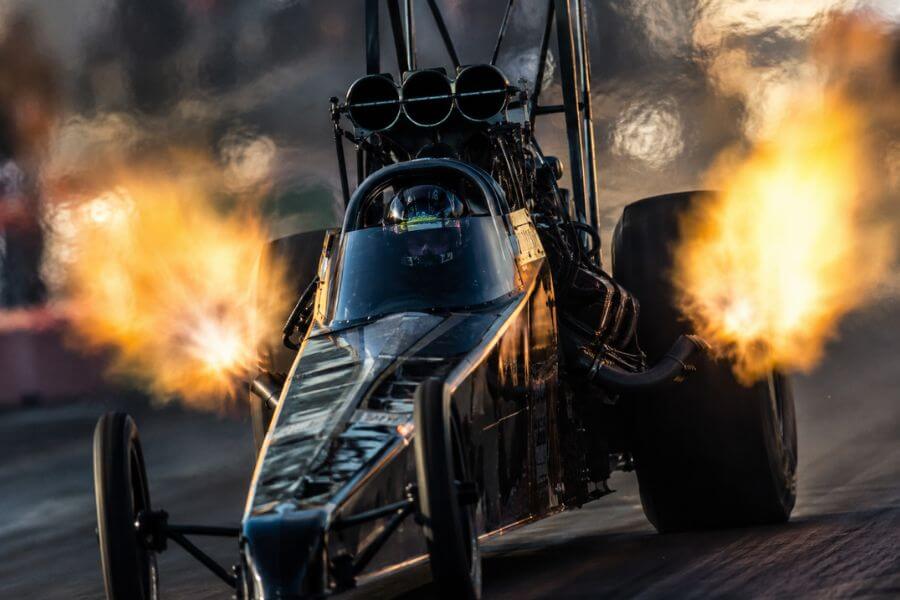
What makes the achievement even crazier is the time involved. The car reached that speed in less than four seconds. During launch, the rear tires wrinkle under pressure, flames burst from the exhaust pipes, and the entire car fights to stay straight.
You would probably think a machine producing this much power could not physically maintain traction. Yet modern drag racing technology somehow keeps these rockets connected to the asphalt.
The run also demonstrated how modern aerodynamics, clutch tuning, and tire compounds have pushed drag racing into a completely different universe compared to earlier decades.
2. The Quickest Quarter Mile Pass ⏱️
One of the most jaw-dropping records in drag racing is the quickest quarter mile ever completed by a Top Fuel dragster. The best runs are now comfortably in the 3.6-second range.
That means a car starts from a complete stop and covers 1,320 feet faster than most people can react to a green light.
Imagine pulling away from a traffic light and already finishing a race before another driver fully presses the gas pedal. That is how absurd modern drag racing performance has become.
Drivers experience incredible G forces during these launches. Their vision can blur, their bodies compress into the seat, and every tiny steering correction matters.
The engines themselves are equally insane. They burn nitromethane fuel so aggressively that mechanics rebuild them after nearly every run. Pistons, bearings, and valves face conditions that would instantly destroy a normal engine.
These records prove drag racing is not just about speed. It is about surviving pure mechanical violence for a few unforgettable seconds.
3. More Than 11,000 Horsepower From One Engine 💪
Most sports cars feel powerful with 400 or 500 horsepower. Hypercars crossing 1,000 horsepower make headlines worldwide. Top Fuel dragsters laugh at those numbers.
Modern nitro engines are estimated to produce over 11,000 horsepower.
That level of power seems physically impossible because the engines are based on old-fashioned V8 layouts that still resemble traditional American engines from decades ago. Underneath the madness, you can still recognize the basic shape.
The engines consume fuel at a shocking rate. During a full pass, they burn fuel faster than a fully loaded Boeing jet during takeoff.
The superchargers force massive amounts of air into the engine while nitromethane creates explosive combustion. Flames shoot from the headers because the fuel mixture continues burning outside the engine itself.
You are not just watching horsepower numbers. You are witnessing controlled explosions happening thousands of times per minute.
4. Launch Forces That Crush the Human Body 🚀
One of the most overlooked drag racing records involves acceleration force. Top Fuel drivers can experience nearly 5 Gs during launch.
That level of force is intense enough to make your body feel several times heavier than normal.
For comparison, many roller coasters stay around 3 to 4 Gs for short periods. Fighter pilots experience similar levels during aggressive maneuvers. Drag racers deal with it instantly from a dead stop.
The launch hits drivers so violently that their internal organs shift backward. Their neck muscles fight to stabilize the helmet while the car rockets forward.
Even breathing becomes difficult for a moment.
What makes this even crazier is how quickly the car transitions from standing still to over 100 mph. The force delivery feels almost unnatural because there is no gradual buildup. It is immediate chaos.
This record shows that drag racing is just as much a physical challenge as it is a mechanical one.
5. Funny Cars Nearly Matching Top Fuel Machines 🎭
Funny Cars look slightly more recognizable than Top Fuel dragsters because they still resemble actual cars. But underneath the body shell, they are complete monsters.
Modern Funny Cars can exceed 330 mph while running times close to Top Fuel dragsters.
That achievement is incredible because Funny Cars are aerodynamically less stable than long wheelbase dragsters. Their shorter dimensions and full body shape make them much harder to control.
Drivers wrestle with these machines constantly during the run. Tire shake, wheelspin, and sideways movement can happen instantly.
The engines still produce outrageous horsepower, and the bodies themselves flex dramatically under speed.
Watching a Funny Car launch at night is unforgettable. Flames pour from the exhaust while the body twists under power. It looks more like a spacecraft malfunction than a racing machine.
The fact that these cars stay pointed in the right direction at over 300 mph feels almost impossible by itself.
6. Electric Drag Cars Rewriting Expectations ⚡
Electric drag cars were once considered a joke compared to nitro monsters. That opinion changed fast.
Modern electric drag racers have recorded astonishing acceleration numbers and quarter-mile times that rival elite gasoline-powered supercars.
The instant torque delivery of electric motors creates brutal launches with almost zero delay. There is no waiting for turbochargers or engine revs. The power arrives immediately.
Some electric drag builds have dipped deep into the 7-second quarter-mile range, which would have sounded impossible for EVs just a few years ago.
What surprises most people is how silent the launches can feel compared to traditional drag racing. Instead of explosive engine noise, you hear tire noise and rapid acceleration.
This record category matters because it proves the future of drag racing may look very different than its past.
Electric performance is evolving much faster than many expected.
7. The Craziest Wheelstanding Record 🛞
Wheelstands are one of drag racing’s most iconic moments. But some racers take it far beyond a brief front wheel lift.
Specialized drag cars have traveled astonishing distances with the front wheels completely off the ground.
Keeping a car balanced during a wheelstand is extremely difficult because the driver loses steering control from the front tires. Small throttle adjustments become critical.
The physics involved are wild. Too much power and the car flips backward. Too little and the front wheels slam down violently.
Long wheelstands require perfect balance between torque, chassis setup, suspension movement, and driver skill.
To spectators, these runs almost look fake because the car spends so much time climbing into the air instead of staying planted on the track.
It is one of the clearest examples of drag racing defying what most people think cars should be capable of doing.
8. Street Legal Cars Running Supercar Crushing Times 🏎️
Some of the most unbelievable drag racing records come from street-legal cars.
Modern high-performance builds with license plates, headlights, and interiors are now capable of quarter-mile times once reserved only for professional race teams.
Cars like heavily modified Nissan GT-Rs, Lamborghinis, and American muscle cars have entered the 6 and 7-second range while technically remaining street legal.
That means a vehicle you could theoretically drive to a grocery store might outrun million-dollar hypercars with ease.
These builds often produce thousands of horsepower while still retaining air conditioning, infotainment systems, and usable cabins.
Traction becomes the biggest challenge. Putting huge power to the ground without instantly destroying the tires takes advanced tuning and suspension design.
The idea that a road-registered vehicle can accelerate this quickly feels almost absurd to everyday drivers.
9. Drag Racing Tires Expanding at High Speed 🎡
One of the strangest records in drag racing involves tire growth.
At extreme speeds, drag racing slicks can expand several inches taller due to centrifugal force. The tires actually stretch and change shape during the run.
This happens because the tires are designed with soft, flexible sidewalls that maximize grip during launch.
As speed increases, the tire diameter grows dramatically. That effectively changes the gear ratio while the car accelerates.
Watching slow-motion footage of this phenomenon looks surreal. The tires appear to inflate and distort like rubber balloons under massive force.
Engineers intentionally use this behavior as part of the performance strategy.
To most people, the idea of tires physically changing size at over 300 mph sounds terrifying rather than helpful. Yet in drag racing, it is completely normal.
10. Motorcycle Drag Bikes Breaking Human Limits 🏍️
Drag racing on four wheels is already extreme. Doing it on two wheels feels even crazier.
Top Fuel motorcycles have exceeded 250 mph in the quarter mile while balancing enormous power through a tiny contact patch.
These bikes launch with violent acceleration and often fight wheelies during the run. Riders must control massive power while staying tucked into an aerodynamic position.
Unlike car drivers, motorcycle racers have almost no physical protection around them.
The engines scream at unbelievable RPM levels while the bikes rocket down the track in just a few seconds.
What makes these records feel impossible is the sheer bravery involved. Maintaining stability on two wheels at those speeds requires incredible focus and precision.
Even tiny mistakes can end in disaster.
These riders operate at the edge of physics every single time they launch.
Conclusion 🏆
Drag racing records continue to redefine what humans and machines are capable of achieving. Every year, engineers and drivers push deeper into territory that once seemed impossible.
From 11,000-horsepower engines to quarter-mile times under four seconds, the sport constantly challenges your understanding of speed, traction, and acceleration.
What makes drag racing so fascinating is the simplicity of the goal. Go straight as fast as possible. Yet achieving that goal demands some of the most advanced engineering and fearless driving in motorsport.
The next time you watch a drag race, remember that you are not just seeing cars go fast. You are watching physics get stretched to its absolute limit.
Frequently Asked Questions ❓
Why do Top Fuel dragsters use nitromethane instead of gasoline?
Nitromethane contains oxygen within the fuel itself, allowing the engine to burn far more fuel during combustion. This creates much greater power than traditional gasoline engines can produce.
How hot do drag racing engines get during a run?
Top Fuel engines can reach extremely high temperatures in just a few seconds. Exhaust flames can exceed temperatures that would destroy regular car components almost instantly.
Why are drag racing engines rebuilt so often?
The stress on the engine is enormous. Internal parts experience violent pressure and heat during every pass, so teams frequently rebuild engines to prevent catastrophic failures.
How do drag racers stop after reaching over 300 mph?
Most Top Fuel and Funny Cars use parachutes along with powerful braking systems. Without parachutes, stopping safely within the shutdown area would be nearly impossible.
What is the most dangerous part of drag racing?
The launch phase is one of the most dangerous moments because the cars experience massive acceleration forces and traction issues. Mechanical failures at high speeds are also extremely dangerous for drivers.