Table of Contents
When you hear the words “artificial intelligence,” you probably imagine futuristic robot cars driving themselves through busy cities. But the truth is much more surprising. AI is already inside many of the cars people drive every single day. You may already be using it without even realizing it.
Modern vehicles rely on smart systems that can learn patterns, analyze information, and make decisions in real time. These features help keep you safer, improve fuel economy, make driving easier, and even entertain you during long trips. From parking assistance to voice commands, AI has quietly become one of the most important technologies in today’s automotive world.
Whether you drive a brand-new luxury SUV or a newer budget sedan, there is a good chance your car already uses some form of artificial intelligence. Let’s explore the most common ways AI is working behind the scenes every time you get behind the wheel.
Quick Summary Table 🧠
| # | AI Feature | What It Does | Why It Matters |
|---|---|---|---|
| 1 | Adaptive Cruise Control | Adjusts speed automatically | Makes highway driving safer |
| 2 | Lane Keeping Assist | Helps keep your car centered | Reduces drifting accidents |
| 3 | Voice Assistants | Understands spoken commands | AI-Powered Fuel Efficiency |
| 4 | Automatic Emergency Braking | Detects possible crashes | Can prevent accidents |
| 5 | Smart Navigation Systems | Learns traffic patterns | Saves time and fuel |
| 6 | Driver Monitoring Systems | Watches for fatigue | Improves driver safety |
| 7 | Parking Assistance | Helps with parking maneuvers | Makes tight spaces easier |
| 8 | Predictive Maintenance Alerts | Detects mechanical problems early | Prevents expensive repairs |
| 9 | Personalized Cabin Settings | Learns your preferences | Improves comfort |
| 10 | AI Powered Fuel Efficiency | Optimizes driving performance | Helps lower fuel costs |
How We Ranked These AI Features ⚙️
We ranked these technologies based on several important factors that affect everyday drivers:
- How common the feature is in modern vehicles
- Real-world usefulness during daily driving
- Safety benefits for drivers and passengers
- Impact on comfort and convenience
- Ability to save money over time
- How much the system relies on real AI learning and decision-making
- Whether average drivers actually use the feature regularly
1. Adaptive Cruise Control 🚦
Adaptive cruise control is one of the clearest examples of AI already working inside your car. Unlike old cruise control systems that only maintained a fixed speed, adaptive systems constantly monitor traffic around you.
Using cameras, radar, and sensors, the car measures the distance between your vehicle and the one ahead. If traffic slows down, the system automatically reduces your speed. Once traffic clears, your car speeds back up again.
What makes this AI-driven is the ability to process real-time traffic conditions and make quick decisions without your input. Some advanced systems can even handle stop-and-go traffic almost entirely on their own.
For you as a driver, this means less stress during long highway drives and fewer sudden braking situations. It also helps improve fuel economy by avoiding unnecessary acceleration and braking.
Many vehicles from brands like Toyota, Hyundai, Ford, Honda, and Tesla already include this feature.
2. Lane Keeping Assist 🛣️
Lane keeping assist uses AI to monitor road markings and help keep your car centered in its lane. Cameras near the windshield continuously scan the road while software analyzes lane positions in real time.
If your vehicle begins drifting without using a turn signal, the system may gently steer the car back into place or warn you with vibrations and sounds.
This technology is especially useful during long drives when fatigue can reduce your focus. AI allows the car to recognize patterns and predict when a driver may accidentally leave the lane.
Some advanced versions work together with adaptive cruise control to create semi-autonomous highway driving systems. These systems are becoming more common every year.
For many drivers, lane keeping assist has quietly become one of the most valuable safety features available today.
3. Voice Assistants 🎤
If you have ever said “Call Mom,” “Play music,” or “Navigate home” while driving, you have already used automotive AI.
Modern voice assistants use natural language processing to understand what you say. Instead of only recognizing exact commands, these systems learn how people naturally speak.
Over time, some systems even adapt to your voice, favorite destinations, and common habits. AI helps reduce misunderstandings and improve response accuracy.
This feature matters because it helps you keep your hands on the wheel and eyes on the road. Instead of touching screens while driving, you can control many vehicle functions simply by speaking.
Cars from brands like Mercedes-Benz, BMW, Tesla, and Hyundai now offer advanced voice systems that feel surprisingly conversational.
4. Automatic Emergency Braking 🚨
Automatic emergency braking may be one of the most important AI safety systems ever added to modern vehicles.
The system constantly scans the road ahead using cameras, radar, and sensors. AI software analyzes vehicle speeds, object distances, and driver reactions in milliseconds.
If the system believes a collision is about to happen and you do not react quickly enough, the car can automatically apply the brakes.
This technology has already prevented countless accidents worldwide. In some situations, it can completely avoid a crash. In others, it reduces the impact speed enough to lower injuries significantly.
The reason AI is so important here is speed. Humans often need more time to react than computers do. AI systems can process huge amounts of information almost instantly.
Today, many governments and safety organizations strongly encourage automatic emergency braking in new vehicles because of its proven safety benefits.
5. Smart Navigation Systems 🗺️
Navigation systems have evolved far beyond simple maps. AI-powered navigation now studies traffic patterns, driving habits, weather conditions, and road closures to recommend better routes.
Some systems even learn your routine. Your car may automatically suggest directions to work in the morning or warn you about unusual traffic before you leave home.
AI also helps calculate arrival times more accurately by analyzing real-world driving conditions instead of just speed limits.
Electric vehicles especially rely heavily on smart AI navigation. Many EV systems automatically plan charging stops, battery usage, and energy-efficient routes.
For you, this means less wasted time in traffic and smoother daily commuting.
6. Driver Monitoring Systems 👀
Many newer vehicles now include systems that monitor your attention while driving. This technology uses cameras and sensors to watch eye movement, steering behavior, and head position.
If the system detects signs of fatigue or distraction, it may issue warnings, suggest taking a break, or activate safety systems.
AI plays a huge role here because the software must recognize human behavior patterns in real time. The system learns the difference between normal driving and dangerous distraction.
This feature is becoming increasingly important as distracted driving continues to rise due to smartphones and long work hours.
Some luxury vehicles can even detect if a driver becomes unresponsive and safely slow the vehicle down automatically.
7. Parking Assistance 🅿️
Parking assistance systems use AI to make one of driving’s most stressful tasks much easier.
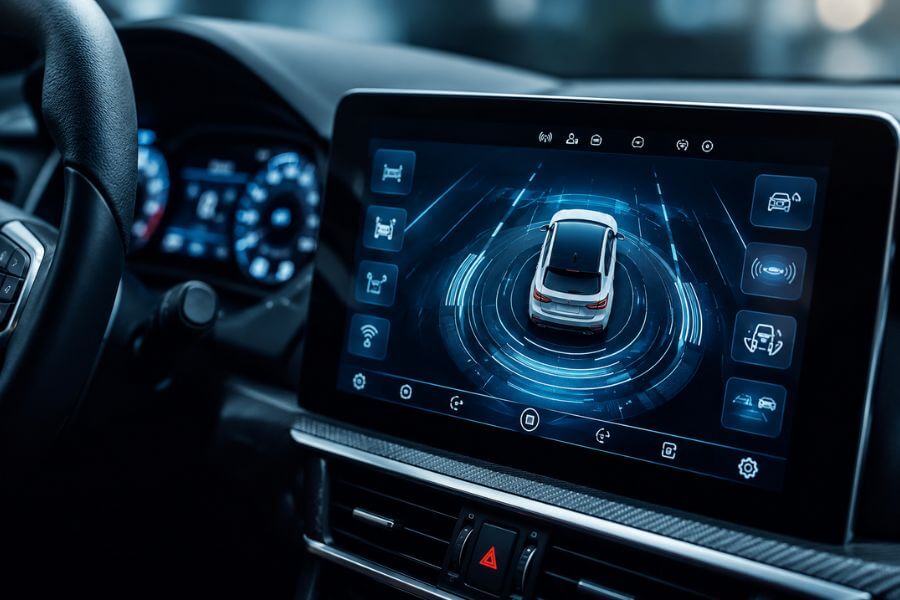
Sensors and cameras scan the area around your vehicle while the software calculates distances and identifies safe parking spaces. Some systems can even steer the car into a parking spot automatically while you control the pedals.
Advanced 360-degree camera systems also use AI image processing to create a virtual overhead view of your car.
This technology is especially helpful in crowded cities and tight parking garages where visibility can be limited.
For many drivers, parking assistance removes anxiety and reduces the risk of scratches, dents, and minor accidents.
8. Predictive Maintenance Alerts 🔧
Modern cars no longer wait for something to break before warning you. AI-powered systems can now predict potential problems before they become serious.
Your vehicle constantly collects data about engine performance, battery condition, braking systems, tire pressure, and fluid levels. AI analyzes this information to detect unusual patterns.
For example, the system may notice slight battery weakness or unusual engine behavior long before a major failure happens.
This helps you schedule maintenance earlier, avoid breakdowns, and reduce expensive repair costs.
Some manufacturers even send diagnostic reports directly to dealerships, so technicians already know what needs attention before you arrive.
Predictive maintenance is one of the most practical examples of AI making car ownership easier and less stressful.
9. Personalized Cabin Settings 🎶
AI is also making vehicles feel more personal than ever before.
Many modern cars can remember your preferred seat position, climate control settings, mirror angles, lighting preferences, and favorite radio stations.
Some systems even learn patterns over time. Your car may automatically warm the cabin during cold mornings or suggest your favorite music playlist during evening commutes.
This type of AI focuses on convenience and personalization. Instead of manually adjusting settings every time you drive, the car adapts to you automatically.
Luxury brands have pushed this technology further, but even affordable vehicles are starting to include smarter personalization systems.
10. AI-Powered Fuel Efficiency ⛽
Fuel efficiency systems now rely heavily on AI to improve performance and reduce fuel consumption.
Modern vehicles analyze acceleration patterns, terrain, traffic conditions, and driving habits to optimize engine performance in real time.
Hybrid and electric vehicles especially depend on AI to balance battery usage, regenerative braking, and power delivery.
Some cars even provide driving tips based on your habits, encouraging smoother acceleration and better braking techniques to improve efficiency.
This technology not only saves money at the gas station but also reduces environmental impact.
As fuel prices continue to rise, AI-driven efficiency systems are becoming more valuable for everyday drivers.
Conclusion 🌟
Artificial intelligence is no longer something reserved for science fiction movies or futuristic concept cars. It is already deeply connected to the vehicles people drive every day.
From safety systems that prevent crashes to navigation tools that save time, AI quietly works behind the scenes to improve nearly every part of the driving experience. In many cases, these features make your car safer, smarter, more comfortable, and cheaper to operate.
What makes this even more interesting is that automotive AI is still evolving quickly. The features you use today are only the beginning. Future vehicles will likely become even more intelligent, more personalized, and more capable of assisting drivers in ways we can barely imagine today.
The next time your car warns you about traffic, helps you park, or automatically adjusts your speed, remember that you are already experiencing the power of artificial intelligence firsthand.
Frequently Asked Questions ❓
Can older cars have AI features added later?
Yes, some AI-related technologies can be added to older cars through aftermarket systems. Dash cameras with driver assistance, smart navigation units, parking sensors, and voice assistants are common upgrades. However, advanced factory-integrated systems are harder to install later.
Is AI in cars the same as self-driving technology?
Not exactly. Many current AI systems assist drivers rather than fully replace them. Features like lane keeping assist and adaptive cruise control help with driving tasks, but most vehicles still require full driver attention.
Do AI car systems collect personal data?
Many modern vehicles collect driving data to improve performance and personalize features. This may include navigation history, driving habits, and vehicle diagnostics. Privacy policies vary depending on the manufacturer.
Can AI features fail during bad weather?
Yes, heavy rain, snow, fog, or dirt on sensors can affect cameras and radar systems. AI safety features are helpful, but drivers should never rely on them completely during difficult weather conditions.
Will AI make cars fully autonomous in the future?
Most experts believe vehicles will continue moving toward higher levels of automation over time. However, fully autonomous driving still faces challenges involving safety, laws, road conditions, and public trust.